Vietnam's Property Market Is Not Collapsing. That's the Problem.
The market looks stable. The bonds are defaulting. The buyers are waiting. The mechanism keeping this together is the same one preventing it from clearing.
Sometime in the past year, a Vietnamese bondholder received notice that their investment was being settled. Not in cash. In an apartment: a unit in a half-built township in Đồng Nai province, two hours from Ho Chi Minh City, in a development that does not yet hold a legal completion certificate. They had not asked for an apartment. They had bought a fixed-income product from a developer whose name they recognised, through a bank branch, because someone told them the returns were good. This is one documented class of transaction within Novaland's 2025 domestic bond restructuring, in which 7 trillion đồng in bonds were settled through asset transfer.
This is not a crime story. The bond was being settled according to a restructuring agreement the bondholder had consented to, because the alternative, waiting longer for cash that might not arrive, was worse. This is a story about how Vietnam's property market handles its failures: not with a collapse, but with a long series of individually explicable transactions that collectively describe a system that cannot clear itself.
The short version
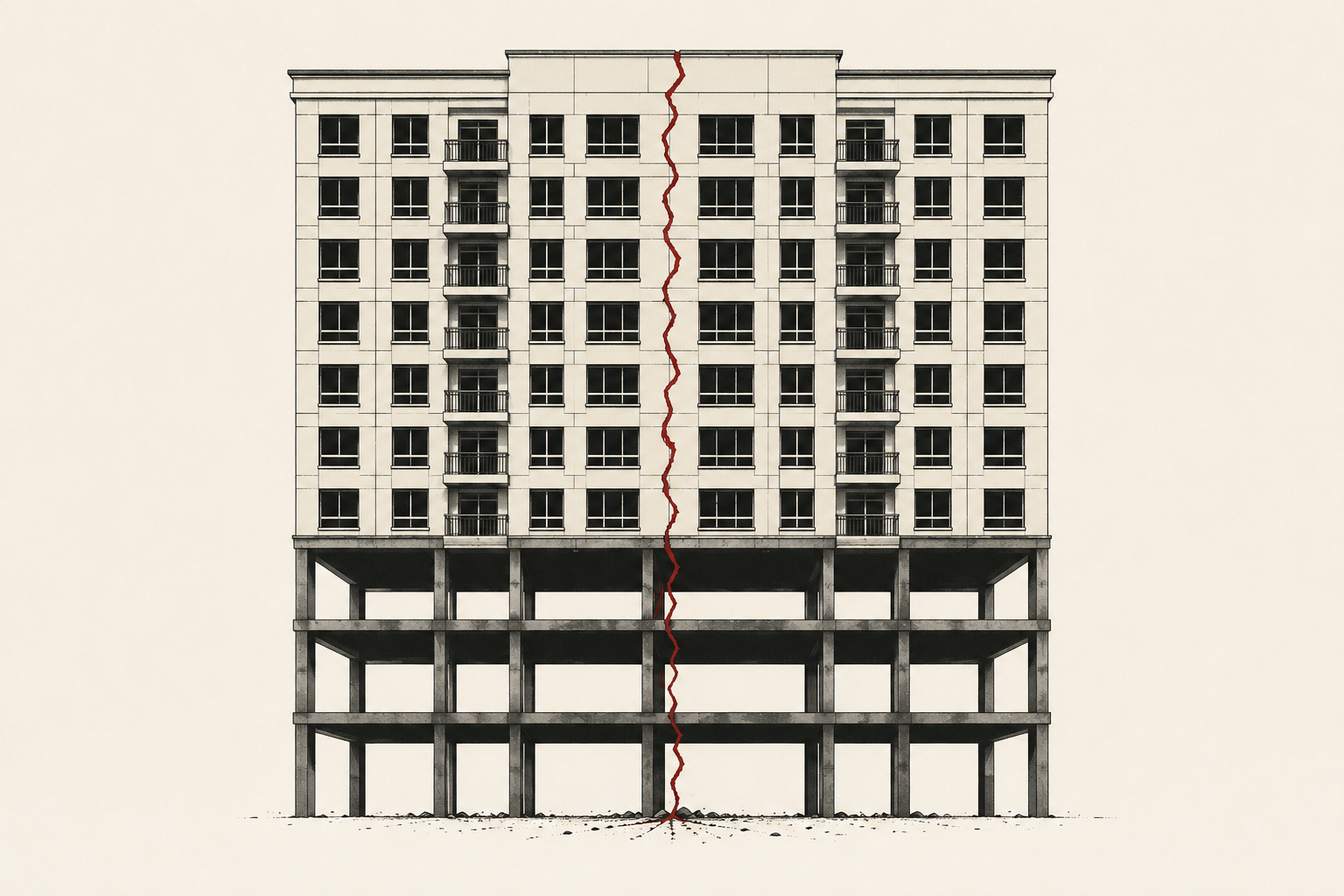
Vietnam's property market is not crashing. Apartment prices in Ho Chi Minh City rose 24% last year. In Hanoi, 33%. Those numbers measure the asking price for the narrow slice of supply still reaching market, not the health of the system behind it. A 2025 government assessment found nearly 2,900 projects stalled nationally, with 2.4 quadrillion đồng in investment frozen inside them. Of those, 926 have been officially resolved: legal obstacles cleared, not construction completed, not apartments delivered. The government is managing this, not resolving it. No property tax means no forced sellers, no forced sellers means no price discovery, and no price discovery means the reckoning stays invisible until it can no longer be deferred.
How the Bonds Were Sold

Between 2019 and 2021, Vietnam's corporate bond market expanded at a pace that suggested everything was working. Real estate developers accounted for roughly 35% of all issuance at the peak. In 2021 alone, the sector issued 232 trillion đồng in bonds, according to VBMA annual report data. Most were privately placed, with disclosure requirements thin enough to be effectively meaningless. Most were not designed to be held by retail investors.
They were anyway. The regulator moved in 2020 to restrict retail access to these "professional" instruments, which required no credit rating, no prospectus, and no independent audit of the underlying assets. Retail investors found ways around the restriction. Sometimes they knew what they were buying. Sometimes a bank teller had framed the product as a savings vehicle, something with a higher return than a deposit and the same institutional feel. The developer's name was recognisable. The branch was the same place they kept their savings account. The logic was legible even if the instrument was not.
The crash came fast. By 2022, real estate bond issuance had collapsed approximately 76%, to an estimated 55 trillion đồng, derived from VBMA's reported total corporate bond issuance of 269.5 trillion đồng and a real estate sector share of around 20.4% that year. The bond market froze almost entirely in late 2022 after high-profile arrests. By May 2023, nearly 25% of outstanding real estate bonds were in default, according to analysis by the Friedrich Naumann Foundation citing State Bank and VBMA data. The government's response, Decree 08/2023, allowed developers to extend maturities without triggering formal default classification. The problems were not resolved. They were rescheduled.
The machine crashed in 2022, and is restarting
Annual real estate bond issuance, trillion đồng. * = estimated.
Sources: VBMA Annual Reports 2021, 2022, 2025 (confirmed). * = estimated.
As of early 2026, the rescheduled problems are coming due again. A new wave of payment delays hit in Q1 2026. VietData, a market data service aggregating exchange and issuer disclosures, classified around 20% of the 259 trillion đồng in outstanding corporate bonds as carrying high default risk in Q1 2026, based on prior coupon delays, leverage ratios, and cash flow metrics. The maturity wall has not been cleared. It has been pushed forward, and it is arriving.
Meanwhile, real estate bond issuance in 2025 reached 147 trillion đồng, the highest level since the 2021 peak, accounting for 23.4% of all corporate bonds issued that year. The machine is restarting. New bonds are being sold into a market where the last cycle's defaults have not been resolved.
The Developers
Novaland is the largest and clearest case. Construction on Aqua City, its flagship township in Đồng Nai, began in 2017. The project was suspended in 2021 over planning disputes. Legal clearance came in late 2024. Full handover of roughly 9,200 units is now targeted for 2026 to 2027. That is nine years from groundbreaking to keys. Buyers have been paying bank installments for most of that period. More than 300 publicly refused to continue servicing their loans for apartments they could not access.
Novaland's total borrowings stand at 67 trillion đồng ($2.58 billion). Its stock recently closed at 14,150 đồng per share. Ongoing bond-to-equity conversions are being executed at a conversion price of 34,000 đồng per share. A bondholder receiving shares under those terms is immediately holding paper worth 58% less than the conversion implies. The restructuring is real. So is the loss embedded in it.
Hung Thinh Land sits in quieter distress. The company rolled over 9.2 trillion đồng in bonds by 24 months, citing unfavourable market conditions. No new projects have been announced. Partial coupon payments have kept it technically outside formal default. In Vietnam's current environment, the distinction between "restructured" and "defaulted" is largely procedural.
Đại Thịnh Phát is worth naming precisely because it is not Novaland. According to reporting by Cafebiz in January 2024, the company, then 99.95% owned by LDG Group, had issued two bond lots totalling 972 billion đồng in mid-2022 at 12.5% annual interest to fund LDG Sky, an apartment block in Bình Dương. Both lots matured in mid-2024. Cafebiz reported that by late 2023, each lot had missed 11 consecutive coupon payments, with the company paying only 10.3 billion đồng in interest across both lots for the entire year. The bonds funded a real project with real buyers. The buyers are still waiting. This is the version of the story that does not make international press.
Vinhomes, Vingroup's property arm, is simultaneously junk-rated by Moody's and Fitch, linked to VinFast's sustained losses, and proposing an $11 billion urban development in central Vietnam. Vingroup is guarantor on $2.54 billion of VinFast's debt. VinFast lost $3.2 billion in 2024. Both rating agencies treated Vinhomes' own balance sheet as a separate matter from the parent; the junk classification reflects group-level linkages, not Vinhomes' standalone position. That separation matters less when the attachment is a guaranteed debt obligation on which, Fitch noted, 41% of interest cost is denominated in US dollars, against a business generating revenue overwhelmingly in đồng.
Sun Group has been appointed by the government to manage the restructuring of Saigon Commercial Bank, under a 15-year plan in which repayments to depositors begin in year 14. At the same time, Sun Group is developing Bình Quới-Thanh Đa, a 357-hectare site on a Ho Chi Minh City peninsula that had been stalled for more than 30 years before the company took it on in 2025.
The pairing is not coincidental. It is a recurring mechanism in how the Vietnamese state manages financial distress: politically connected developers absorb the system's hardest problems (failed banks, unresolvable legacy projects) in exchange for regulatory access to opportunities that cannot be awarded through normal competitive channels. Bình Quới-Thanh Đa is $3.8 billion in investment potential on land that nobody else could touch. That is the consideration. The SCB obligation is the price.
This arrangement does not appear in any official account as a transaction. It is not disclosed as such. But it is the mechanism that keeps the system functional without requiring any of its failures to be publicly recognised. Developers with political proximity become the system's shock absorbers. Developers without it absorb their losses alone.
FLC Group sits at the other end of that spectrum. Its founder, Trịnh Văn Quyết, was arrested in 2022 for market manipulation and securities fraud. The company went through restructuring. In April 2026, FLC broke ground on a 20 trillion đồng resort and urban complex in Gia Lai province. The question the piece does not yet have an answer for is who is financing this, and whether any of the same retail bond distribution channels are involved. That the project exists at all, with the founder's legal case unresolved, tells you something about the system's tolerance for continuity.
| Developer | Key project | Started | Status | Debt |
|---|
The Price That Doesn't Mean What It Says
Ho Chi Minh City apartments averaged around $4,057 per square metre in Q4 2025, up 24% year-on-year. Hanoi averaged $3,000, up 33%. These figures are cited frequently as evidence that Vietnam's property market is recovering. They are measuring the wrong thing.
What is rising is the asking price for the narrow slice of supply still reaching market: high-end units from the few developers who can still access construction financing, sold to the shrinking pool of buyers who qualify for mortgages at current rates. Around 25% of new apartment supply in 2025 was priced above 100 million đồng per square metre. The mid-market, which accounts for the bulk of genuine demand in both cities, barely exists as new inventory.
When a market loses its middle, prices do not fall. They rise, because only the expensive things are transacting. A rising index in a thin market is not a signal of health. It is a signal of who has been priced out.
How a Managed Non-Collapse Works
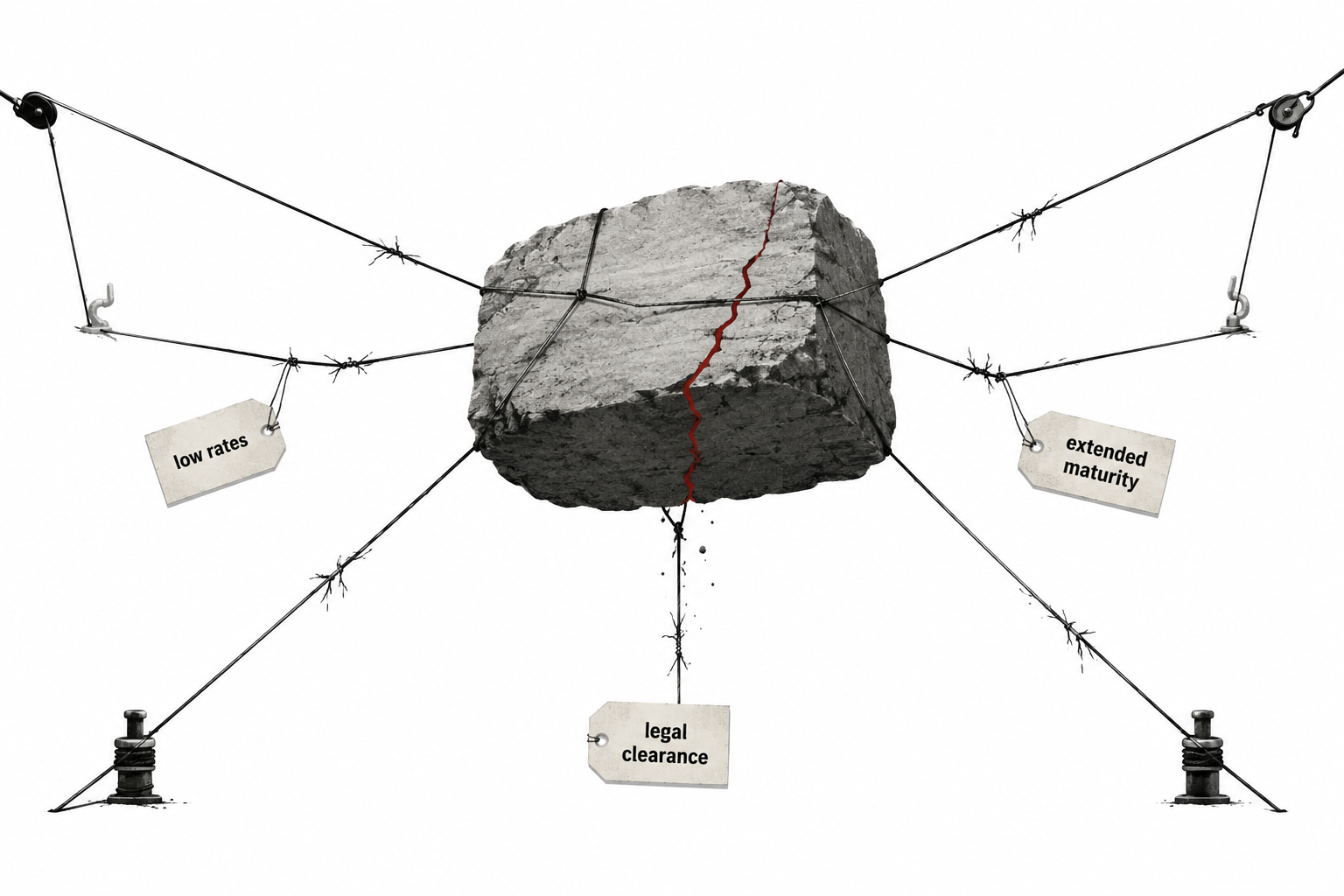
Vietnam has no property tax. A unit sitting empty in a half-built development costs its owner almost nothing to hold. This removes the mechanism that normally forces price discovery: the carrying cost that eventually makes holding more expensive than selling. Without forced sellers, there is no reference price for distress. The market can stay technically alive indefinitely.
The scale of what is waiting to clear is not small. A 2025 government assessment identified approximately 2,900 stalled real estate projects nationally, with an estimated 2.4 quadrillion đồng in investment trapped inside them. The government has declared 926 of those projects officially "resolved." That word requires reading carefully. In this context, resolved means legal obstacles cleared through the new Land Law and Housing Law framework. It does not mean construction restarted, completion certificates issued, or apartments delivered. Legal clearance is step one. The remaining steps, financing, building, regulatory sign-off, handover, are not guaranteed by a clearance letter. The 2,065 projects still awaiting resolution are, by the government's own count, unresolved exposure.
The government is actively maintaining this condition. In May 2026, the Prime Minister asked banks to reduce lending rates to the lowest possible level. Lower rates extend the runway for overleveraged developers, reduce mortgage costs for marginal buyers, and push the moment of reckoning further forward.
The pattern across developers is consistent. Debt gets extended. Bonds get rolled or converted. Criminal investigations move through procedural stages; whatever the cause, the pace has not disrupted markets. Projects receive legal clearance in phases. Press releases announce construction restarts. The forward-looking language does not stop.
This is what a managed decline looks like from the outside. No single visible collapse. A long series of extensions, conversions, and announcements, each individually explicable, collectively describing a system that cannot clear itself.
Who Pays
The developers' shareholders have already taken most of their losses. Novaland's stock is down more than 80% from its peak. The market knew, eventually.
The bondholders are a different matter. The Tan Hoàng Minh case is the clearest documented example. According to the first-instance court verdict in 2023, reported by VnExpress International, 6,630 investors put 10.3 trillion đồng into nine bond packages issued by three of the group's subsidiaries between July 2021 and March 2022. The instruments were legally classified as professional bonds, restricted to institutional investors. They were sold through channels that made them accessible to retail buyers. Of the total raised, 8.6 trillion đồng was misappropriated. Đỗ Anh Dũng, the group's chairman, was convicted. The family subsequently returned the full 8.6 trillion đồng. These were not sophisticated credit investors absorbing a calculated risk. They were people who thought they were saving.
The apartment buyers are a third group, and the least visible. They signed contracts, made down payments, and now service bank loans on units they cannot legally occupy. Their exposure does not appear clearly in bank non-performing loan figures because the loans are technically performing: the buyers are still paying. The asset those loans are secured against, an apartment in a development without a completion certificate, does not legally exist as transferable property yet. The scale of this exposure is not publicly reported in any consolidated form; the Ho Chi Minh City Development Research Institute estimated in 2024 that some 126 projects in the city alone faced legal delays affecting handover timelines, but a national figure for the loan balance sitting against uncertificated units has not been published by the State Bank or any regulator.
The 7 trillion đồng in Novaland domestic bonds settled via asset transfer means some bondholders received apartments instead of cash. Where those apartments are, what they currently trade for in a market with no mid-segment liquidity, and whether they carry valid completion certificates is not disclosed in any standardised way. The loss is real. It is just not yet recognised anywhere official.
What to Watch
Bond default rates in Q2 and Q3 2026 will indicate whether the maturity wall is being absorbed again or beginning to crack. The 20% high-risk portion of outstanding bonds has been the key figure; watch whether it holds or rises as more 2023 extensions come due.
Novaland's Aqua City handover numbers against the 9,200-unit target are a useful ground-level signal. Delivery is the only mechanism that converts paper assets into real ones and begins to release collateral back into the system. If handovers lag significantly, the financial pressure on buyers and banks will compound.
The State Bank's rate direction matters more than it appears. The current posture, pushing rates down, is buying time. Any reversal driven by inflation or currency pressure removes the primary tool keeping the most overleveraged developers operational.
One thing is absent from every official statement about Vietnam's property market: the word crash. That is not evidence that one is coming. It is evidence that the current framework is functioning as designed. The question is how long the design holds.
Sources
| Source | Detail |
|---|---|
| CBRE Vietnam Market Outlook 2025 | HCMC average apartment price $4,057/sqm, Q4 2025; +24% YoY |
| The Investor, Feb 2026 | Hanoi apartment prices +33% YoY; 25% of supply priced above 100 million đồng/sqm |
| VBMA Annual Reports 2021, 2022, 2025 | Real estate bond issuance: 2020: 169.7T đồng; 2021: 232.3T đồng peak; 2022: ~55T đồng; 2025: 147.4T đồng |
| Friedrich Naumann Foundation, Aug 2023 | Default rate 11.74% May 2023; real estate bonds ~25% default; cites State Bank and VBMA data |
| VietData, Q1 2026 | ~20% of 259 trillion đồng in outstanding bonds classified high default risk |
| VnExpress International, 2023 | 300+ Novaland customers publicly refusing bank loan payments on delayed projects |
| The Investor, Apr 2026 | Novaland bond-to-equity at 34,000 đồng/share; NVL stock at 14,150 đồng |
| Cafebiz / Vietnam.vn, Jan 2024 | Đại Thịnh Phát: 972 billion đồng in bonds; 11 missed coupons each lot; 10.3 billion đồng paid in 2023; LDG Sky, Bình Dương |
| The Investor / VnExpress, Nov 2023 | Hung Thinh Land: 9.2 trillion đồng rolled 24 months, Sep 2023 |
| Moody's / Fitch via Reuters, Jan 2025 | Vinhomes junk rating; Vingroup $2.54B VinFast guarantee; 41% USD interest (Fitch) |
| VinFast financial results, 2024 | Net loss $3.2 billion in 2024 |
| Caproasia, Mar 2025 | Sun Group appointed to manage SCB restructuring; repayments begin year 14 |
| The Investor, Feb 2026 | Sun Group, Bình Quới-Thanh Đa $3.8 billion project |
| The Investor, Apr 2026 | FLC breaks ground on 20 trillion đồng Gia Lai project |
| VietnamNet, 2025 | ~2,991 stalled projects; 926 resolved (legal clearance only, not construction completed); 2,065 pending; 2.4 quadrillion đồng frozen |
| VnExpress International, 2023 | Tan Hoàng Minh verdict: 6,630 investors, 10.3T đồng raised, 8.6T đồng misappropriated; convicted; full amount repaid |
| The Investor, May 2026 | PM requests banks cut lending rates to lowest possible level |
| Novaland FY2025 HoSE filing | Total borrowings 67 trillion đồng ($2.58B); 7T đồng domestic bonds settled via asset transfer Jan 2025 |
| HCMC Development Research Institute, 2024 | 126 projects in HCMC facing legal delays affecting handover timelines |